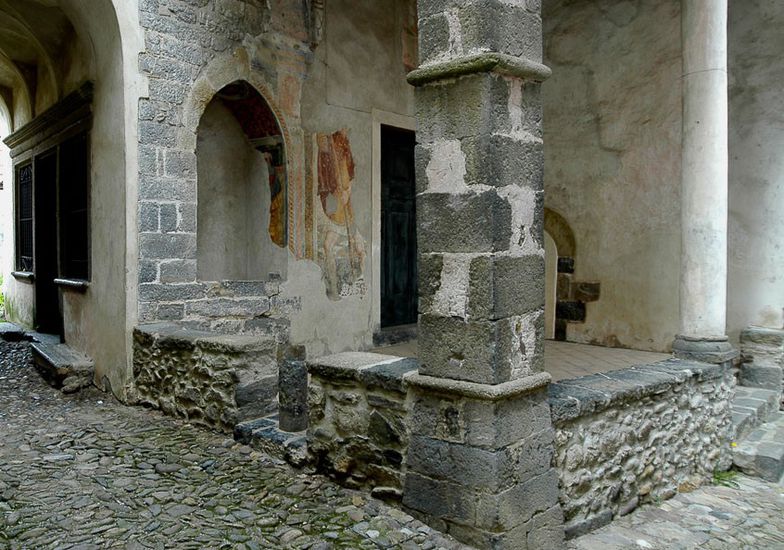
The shrine Madonna del Frassino according to tradition commemorates the prodigious event of a local man who ran into a team of bandits who beat him up and tied him to an ash tree, robbed him and threatened to kill him.
The unfortunate man was in danger of dying because the road was deserted, but he did not lose heart and invoked Our Lady, who appeared to him in the guise of a caring woman and freed him. Returning to the village, he informed the population of the miracle and advocated the construction of a votive chapel at the place where he had been miraculously cured.
The chapel immediately became a place of devotion and was later modified, enlarged and decorated until it assumed its present structure.
In ancient times the area on which the shrine stands was called “Prato del Forno,” due to the presence of an iron ore smelting furnace that was mined in the mines in the area, the existence of which is documented as early as 1223, and the shrine also had this name (Madonna del Forno).
The building, in late Baroque style, has a single nave; the altar is decorated with a beautiful 18th-century Byzantine icon depicting the Madonna and Child and accompanied by the 17th-century wooden choir.
On the right side of the nave is a fine pulpit from the late 17th century, a valuable work of carving and inlay by master Antonio Rovelli of Cusio and his son Ambrogio. On the left side is a characteristic “positive” organ, i.e., suitable for moving as needed, made in 1737 from part of the old organ of the parish church.