


The Val Brembana painter who gave a face to the soul of the seventeenth century
Born in San Giovanni Bianco in 1609, in the Grabbia district, Carlo Ceresa is one of the most prominent artistic figures of the Brembana Valley and one of the leading Lombard painters of the 17th century. His production developed mainly along two areas: sacred painting and portraiture, both of which he approached with constant attention to human reality and the social context in which he worked.
In the field of portraiture Ceresa won wide acclaim already among his contemporaries, thanks to his ability to render with physiognomic accuracy e psychological depth the characters of his time: nobles, religious, administrators, but also people related to his family circle. The figures are depicted without idealizations, with a strong sense of presence and a direct rendering of attitudes and looks, elements that led critics to place him among the greatest Italian portrait painters of the seventeenth century.
Alongside this, sacred production occupies a central part of his career. Ceresa developed a pictorial language strongly rooted in the popular religiosity, far from the more academic schemes and formal conventions demanded by high ecclesiastical hierarchies. His Madonnas, saints and biblical scenes are built on a concrete, recognizable physicality, often inspired by real faces. A choice that makes his works particularly close to the faithful and that, in the context of the seventeenth century, represented a clear and consistent artistic position.
Raised and trained in an environment peripheral to the great artistic centers, Ceresa was nevertheless able to elaborate a personal synthesis between Lombard tradition, Venetian suggestions and teachings learned during the Milanese period at Daniele Crespi. The result is a mature painting, capable of combining compositional rigor and expressive immediacy, today considered an important key to understanding the history, culture and sensibility of the Val Brembana.


The style
Carlo Ceresa's style is often referred to as “Venetian ancestry” because of the’use of intense colors e sharp color combinations, employed with the aim of making the image clear and comprehensible even to an audience without artistic training. The light is functional to the legibility of the figures, while the composition favors the balance and stability of the scenes.
In sacred painting, Ceresa's focus is on the corporeity of the characters and the emotional rendering of the faces, elements that contribute to a concrete and accessible religious narrative. In portraits, on the other hand, there emerges a particular attention to physiognomic details, clothing and posture, tools through which the artist restores the social role and character of the subject represented.
This stylistic consistency, combined with an extensive and continuous production, has made Ceresa's work immediately recognizable and deeply linked to the territory in which it was born.


Ceresian itinerary
The most effective way to learn about Carlo Ceresa is to walk through the places where he worked.
Numerous works are preserved in his native area that provide direct evidence of his connection with the Brembana Valley and local communities.

Carlo Ceresa Museum Museum

Church of St. Bernard Sacred art

Parish Church of Cornalba Sacred art


Church of San Rocco Sacred art

St. Peter and Paul Parish Church Sacred art

Parish Church of St. John the Baptist Sacred art

Plebian Archpriesthood Sacred art

Church of St. James the Apostle Sacred art
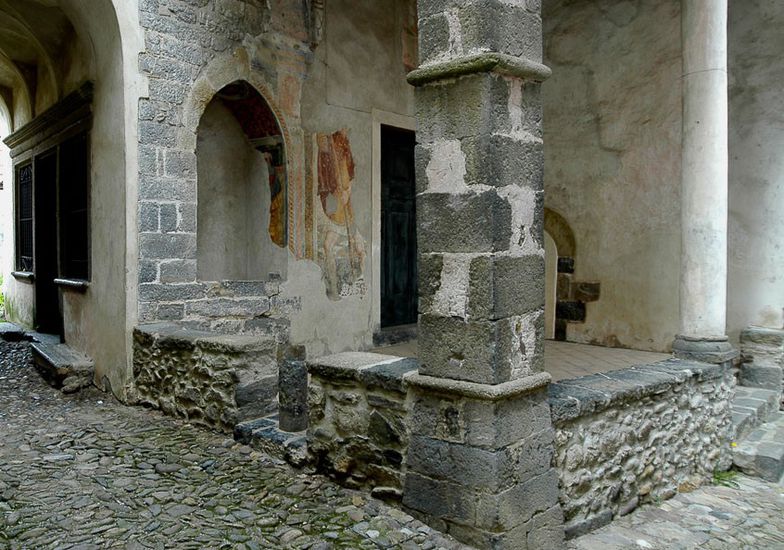

Holy Trinity Monastery Sacred art

San Pellegrino Terme Parish Church Sacred art


Parish Church of St. Anthony Abbot Sacred art

Parish church of Serina Sacred art

Parish Church of St. Martin Sacred art

St. James the Greater Church of Baresi Sacred art

Parish Church of St. Mary of the Assumption Sacred art
