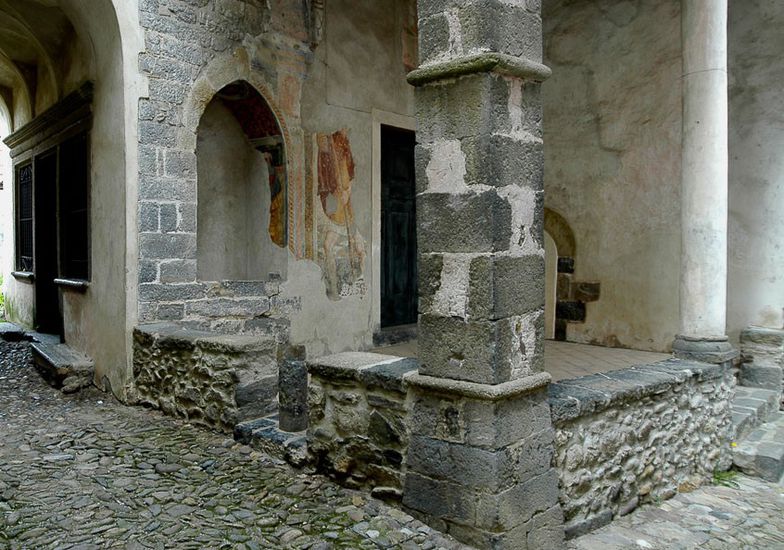
Seventeenth-century shrine that is reached by a short staircase, leaving the driveway to the right. The current dedication is linked to Marian devotion for the narrow escape of the plague of 1759, which since the 1960s has been joined by dedication to the many emigrants who had to look elsewhere for the work that Cassiglio and the valley could no longer offer.
The shrine was first built in 1630, the year of the terrible plague, established as a church for the plague victims, a place of isolation and burial for the plague victims. The church was completely rebuilt, lengthened and elevated in the second half of the 19th century and dedicated to Our Lady Immaculate, whose dogma had been proclaimed by Pope Pius IX on December 8, 1854, the day, even today, of the feast day.
The interior is bare and linear, single-nave, with the presence on the chancel of ample reconstruction of the Lourdes grotto with statues of the Virgin and Bernadette, a work made in the 1960s. The balustrades and floor are a pageantry of local marble to enhance the people's attachment to their shrine. In the sacristy, the large carved and inlaid credenzone, built between 1731 and 1754, when the sacristy was made, is the work of the workshop of the Rovelli marangoni of Cusio. The bell tower, also erected in the late 1800s, made of cement stone, culminates in a statue of Our Lady Immaculate, a work that recalls the St. Bartholomew on the parish bell tower, created in 1899 by sculptor Eugenio Goglio di Piazza, better known as the Valley Photographer.
The shrine after the mid-20th century was also dedicated to the memory of the many emigrants from Cassiglio who had left the village in previous decades for work, mainly to France. Every year the feast of the Immaculate Conception is celebrated on December 8 with a solemn mass and a procession from the shrine to the village with the statue of Our Lady.
Free visit ( see Altobrembo guides, volume I itinerary 2). Included in the itinerary on the Rovelli
Guided tours by appointment.