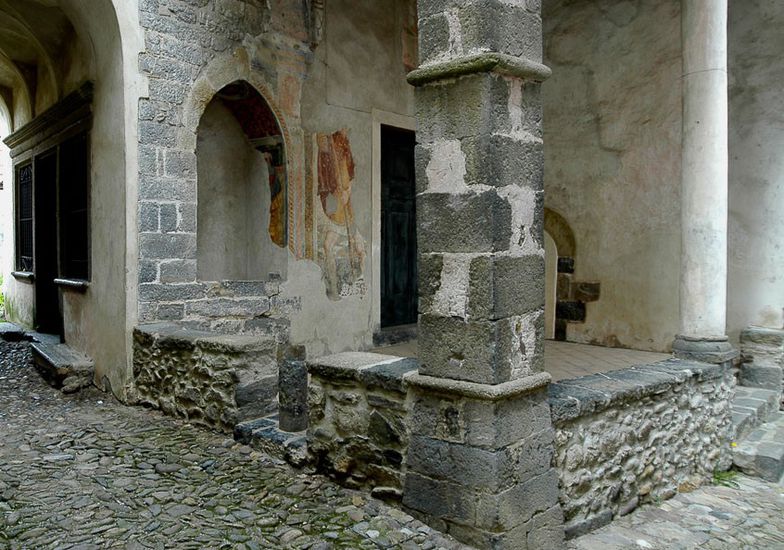
The Oratory of St. John the Baptist is located along the ancient road that connected Cusio with Ornica, on the edge of the saddle of the pass and in front of the plain where for centuries woodcutters produced charcoal.
The church, transformed into today's oratory, has been documented since the Middle Ages. The setting of a Romanesque building, with a beautiful stone portal, small windows for soft, diffuse light, a slight gabled roof and a bell tower proportionate in height and slenderness, is common to the ancient churches of the Upper Valley. The interior has a simple, squared-off hall, and climbing two steps leads to the chancel with groined vaults.
The cycle of frescoes adorning the triumphal arch and chancel is very beautiful, simple in their scenes, spontaneous in their descriptions and fresh in their images. They are the work of Cristoforo Baschenis, called the Younger (1561-1626), one of many fresco painters in the Valley and executed in 1583. On the triumphal arch is the Annunciation and on the chancel scenes from the life of St. John, as well as figures of St. Mary Magdalene, St. Margaret, St. Francis and St. Anthony. Along the nave is a fresco of a beautiful Madonna with the name of the offerer and the year 1581. The predella, the only remaining part of the ancient altar, is the work of inlay by local artist Antonio Rovelli (1640-1710), as is the credenzone in the sacristy.
Included in the itineraries : The Land of the Baschenis and Rovelli. Information at: Altobrembo, Tourist Office former Pianetti Sawmill.